
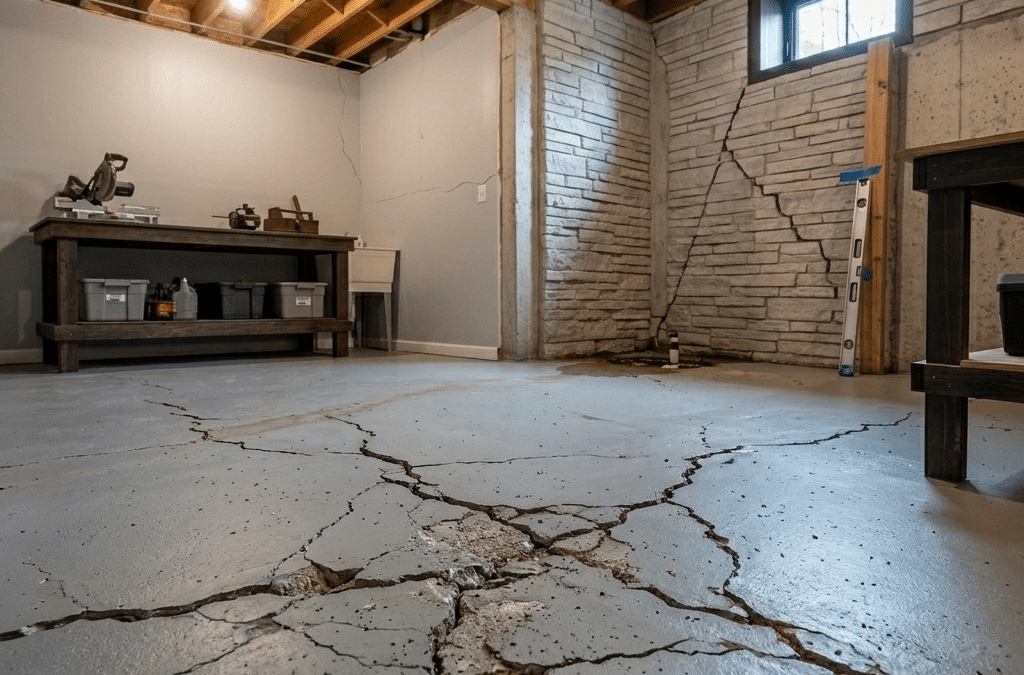
Most homeowners notice a crack in their basement floor at some point and aren’t sure whether to worry about it. The honest answer: it depends. Some basement floor cracks are a normal part of concrete aging. Others are signs of something happening beneath the slab that warrants professional attention. Knowing which is which could save you from either unnecessary anxiety or an expensive problem left to grow.
Why Basement Floors Crack
Concrete shrinks slightly as it cures, and virtually all concrete slabs develop some cracking over time. But basement floor cracks are also caused by forces below the slab — soil movement, settlement, hydrostatic pressure, and erosion — that have nothing to do with the concrete itself. Understanding the cause determines the urgency and the fix.
Types of Basement Floor Cracks
Hairline Cracks
Very thin cracks (under 1/8 inch) that follow no particular pattern and have no vertical displacement — meaning both sides of the crack are at the same level. Usually the result of concrete shrinkage during curing. Low concern on their own, but worth monitoring. If they begin to widen or show displacement, reassess.
Diagonal Cracks
Cracks running at an angle across the floor, often radiating from a corner or entry point. Can indicate differential settlement — one section of the slab settling faster than another — or soil heave pushing up unevenly beneath the slab.
Cracks with Vertical Displacement (Step Cracks)
When one side of a crack sits higher or lower than the other, the slab has shifted vertically. This is a reliable sign that something is happening in the soil below — either settlement creating voids or heave pushing sections up. Cracks with vertical displacement warrant professional evaluation.
Wide or Growing Cracks
Any crack wider than 1/4 inch, or one that has visibly widened since you first noticed it, signals active movement. Monitor with crack gauges or tape the crack and mark the edges with a date. If it continues to grow, the underlying cause needs to be identified and addressed.
Cracks with Water Intrusion
Water seeping through basement floor cracks indicates hydrostatic pressure beneath the slab. This is both a water management problem and a signal that the soil below is saturated — conditions that promote erosion and void formation over time.
What Causes Serious Basement Floor Cracks?
- Soil settlement or compaction — voids forming beneath the slab as soil shifts or washes away
- Hydrostatic pressure — saturated soil beneath the floor pushing upward
- Foundation settlement — the entire foundation moving, which stresses the slab
- Tree root intrusion — roots growing beneath the slab and displacing soil
- Plumbing leaks — water from broken drain or supply lines eroding the sub-slab soil
- Freeze-thaw heave — soil frozen beneath the slab expanding upward and cracking it from below
How Basement Floor Cracks Are Repaired
The repair depends entirely on the cause:
- Cosmetic crack filling — for stable, non-structural cracks, polyurethane or epoxy injection seals the crack and prevents water or radon entry
- Void filling — polyurethane foam injection fills voids beneath the slab, restoring support and stabilizing the concrete against further cracking or sinking
- Slab lifting (foam jacking) — for slabs that have settled, foam injection beneath the slab lifts it back toward level with minimal disruption
- Interior drainage system — for floor cracks with water intrusion, a perimeter drainage channel beneath the slab captures water and routes it to a sump pump
- Foundation stabilization — if floor cracks are driven by larger foundation settlement, pier systems address the root cause before the floor is repaired
Central Indiana Homeowners: Don’t Patch Without Diagnosing
The most common mistake homeowners in Indianapolis, Carmel, Fishers, Noblesville, and Greenwood make with basement floor cracks is filling them without understanding what’s driving them. A crack that’s actively widening or taking on water will not stay filled — and patching it delays the proper fix.
Trusted Foundation Solutions offers free inspections throughout central Indiana. We assess basement floor cracks in context — looking at the whole foundation picture to determine whether what you’re seeing is cosmetic or structural — backed by our satisfaction guarantee and lifetime warranty.
📞 Call us today or fill out our contact form to schedule your free inspection. Not every crack is an emergency — but the ones that are won’t wait.
Trusted Foundation Solutions proudly serves Indianapolis, Carmel, Fishers, Noblesville, Greenwood, and communities throughout central Indiana.