
Your basement wall is bowing. Maybe it’s a slight curve you noticed during a home inspection, or maybe you can already see a horizontal crack running across the middle of the wall. Either way, you’re looking at a wall under pressure — and it’s not going to stabilize on its own.
Carbon fiber basement wall reinforcement is the most effective, least invasive solution available for bowing and cracking basement walls. It stops movement permanently, it doesn’t require excavation, and it doesn’t take up space in your basement. Here’s everything you need to know before making a decision.
Why Basement Walls Bow and Crack
Basement walls fail because the soil outside them is pushing inward. That pressure — called lateral soil pressure or hydrostatic pressure — builds as water saturates the ground around your foundation. In central Indiana, the clay-heavy soil retains water longer than most soil types, meaning the pressure against your walls is higher for longer stretches of the year.
Horizontal cracks across the middle of a basement wall are the clearest sign that lateral pressure is winning. The wall is being pushed from the outside, and it’s deflecting inward. Left unaddressed, that deflection progresses — slowly at first, then faster as the crack widens and the structural integrity of the wall deteriorates.
A wall that has moved 2 inches inward is already in serious territory. A wall that reaches 3 inches or more of deflection may be beyond what carbon fiber can address on its own.
What Is Carbon Fiber Basement Wall Reinforcement?
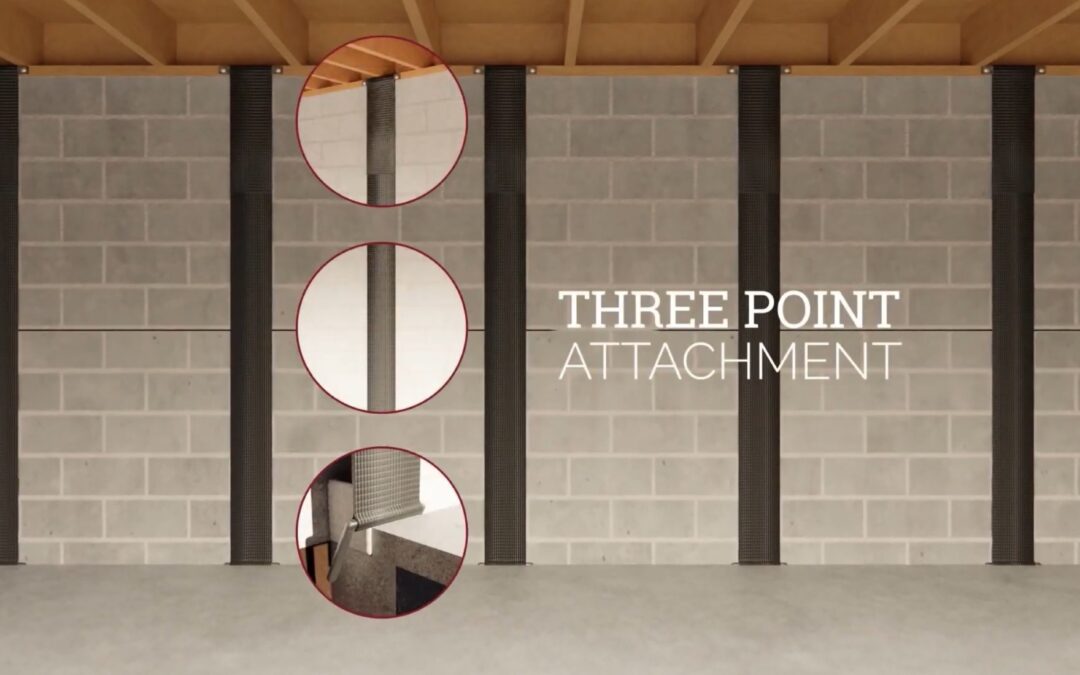
Carbon fiber reinforcement uses high-strength carbon fiber straps bonded directly to the face of your basement wall to halt inward movement. The straps are anchored at the top (to the floor joist or sill plate) and at the bottom (to the footing), creating a vertical tension system that resists the lateral soil pressure pushing against the wall.
The key to why it works — and why not all carbon fiber products are equal — is in the bond between the strap, the epoxy, and the concrete wall. Quality straps use an open-grid weave that allows epoxy to penetrate fully through the strap and into the wall surface, locking the two together at thousands of contact points. A smooth or woven strap can’t achieve that bond, and a weak bond means the system eventually fails.
Trusted Foundation Solutions installs carbon fiber straps engineered for maximum tensile strength and permanent adhesion — not a temporary fix, but a structural solution backed by our lifetime warranty.
Carbon Fiber vs. Other Wall Repair Methods
Homeowners researching bowing wall repair will encounter several options. Here’s how carbon fiber compares:
- Carbon fiber straps — Non-invasive, no excavation, minimal disruption, installed in hours, permanent when properly bonded. Best for walls with less than 2 inches of inward deflection.
- Wall anchors — Steel plates anchored into the yard soil, connected by a rod through the wall. Effective at halting movement and can be gradually tightened over time to recover some straightening. Works at greater deflection than carbon fiber alone.
- Steel I-beams — Floor-to-ceiling steel beams installed against the wall to brace it in place. Strong, but take up basement space and are typically used for significantly compromised walls.
- Excavation and wall replacement — The most invasive and expensive option, reserved for walls that have failed structurally and cannot be saved by reinforcement.
For most homeowners with early to moderate bowing — the horizontal crack is present but deflection is under 2 inches — carbon fiber reinforcement is the right call. It’s the least disruptive path to a permanent solution.
What the Carbon Fiber Installation Process Looks Like
One of the biggest advantages of carbon fiber reinforcement is how fast and clean the installation is. Here’s what to expect:
- Wall surface preparation — The installation area is ground smooth so the epoxy bonds directly to solid concrete
- Epoxy application — A structural epoxy is applied to the wall in the strap locations
- Strap placement and pressing — The carbon fiber strap is pressed into the epoxy, and additional epoxy is worked through the open grid to create full penetration contact
- Top and bottom anchoring — The strap is secured at the floor joist above and the footing below, completing the tension system
- Cure time — The epoxy cures fully within 24 hours; the basement is usable again the same day
Most installations are completed in a single day. There’s no excavation, no heavy equipment in the yard, and no major disruption to your home or daily routine.
How to Know If Carbon Fiber Is Right for Your Wall
Carbon fiber basement wall reinforcement is the right solution when:
- You have a horizontal crack in your basement wall
- The wall has deflected inward but less than 2 inches
- You want a permanent repair without excavation
- You want the repaired area to remain paintable and finished
- You need a solution that won’t reduce your basement’s usable space
It may not be sufficient on its own if the wall has moved more than 2 inches, if the wall has multiple failure points, or if there is active water intrusion through the crack that needs to be addressed simultaneously. A professional assessment will identify which solution — or combination of solutions — is appropriate for your specific situation.
Every carbon fiber installation by Trusted Foundation Solutions comes with a satisfaction guarantee and a lifetime warranty. The strap is rated for the life of the structure. So are we.
Central Indiana Homeowners: Get an Expert Assessment Before the Wall Moves Further
In Indianapolis, Carmel, Fishers, Noblesville, Greenwood, and throughout central Indiana, bowing basement walls are a common consequence of the region’s clay-heavy soil and wet seasonal cycles. The lateral pressure that creates horizontal cracks doesn’t let up — it builds. A wall that looks manageable today can become a structural emergency within a few seasons if left unaddressed.
Trusted Foundation Solutions offers free inspections throughout central Indiana. We’ll measure the deflection, assess the crack, and give you a straight answer about whether carbon fiber reinforcement is the right fix — and what it will take to get your wall stable and protected.
Call us today or fill out our contact form to schedule your free inspection. A bowing wall is a problem that only moves in one direction without intervention — let’s stop it now.