
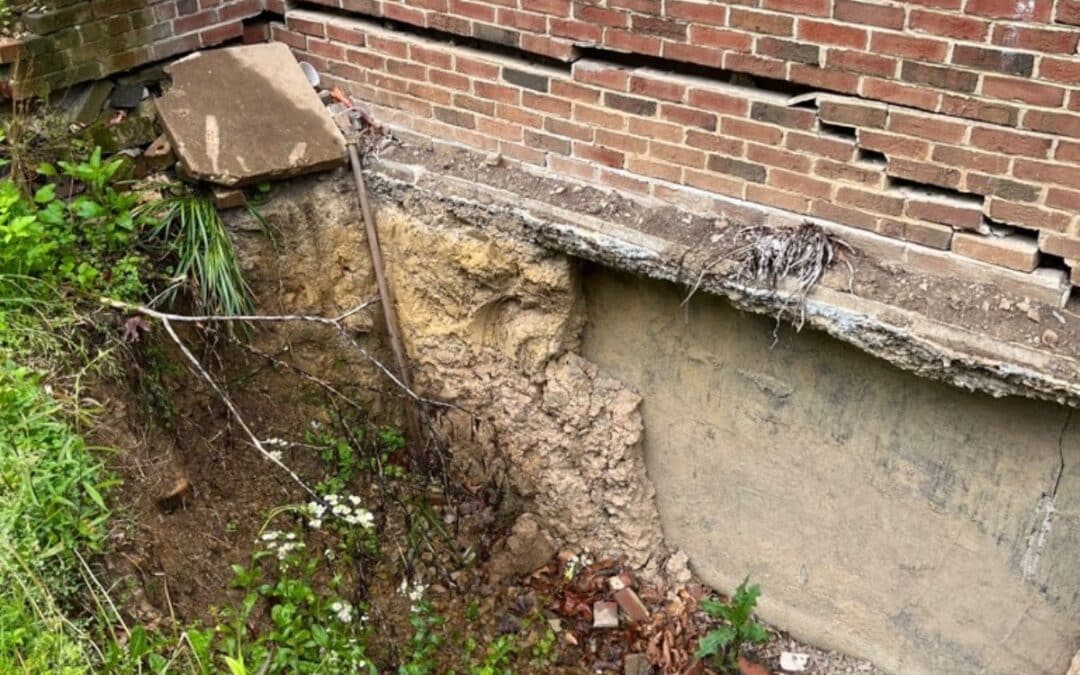
Your foundation doesn’t just sit on the ground — it depends on the ground. The soil beneath and around your foundation is what holds everything in place. When that soil erodes, washes away, or compresses into voids, your foundation loses the support it was built on. And without support, it moves.
Foundation erosion is one of the leading causes of structural damage for central Indiana homeowners, and it’s particularly deceptive — the process happens underground, out of sight, often for years before symptoms appear inside the home. By the time you notice something wrong, erosion may have already created significant voids beneath your slab or footing.
Here’s what you need to know.
What Is Foundation Erosion?
Foundation erosion is the gradual displacement or loss of soil that supports your foundation. It’s not a single event — it’s a process that unfolds over months and years as water, drainage failures, and soil conditions work against the ground your home sits on.
There are two primary forms:
Surface erosion occurs when water runoff carries soil away from around the foundation’s perimeter. This is visible over time as the grade around your home changes — soil that once sloped away from the house flattens or reverses, directing water toward the foundation instead of away from it.
Subsurface erosion (also called soil piping or internal erosion) occurs when water moving through the soil carries fine particles away from beneath the foundation or slab. This creates hidden voids — empty spaces underground that offer zero support. A slab or footing spanning a void is under stress every single day, and eventually something gives.
What Causes Foundation Erosion in Central Indiana?
Indiana’s climate and soil composition create ideal conditions for foundation erosion. Here’s what drives it:
- Heavy rainfall and surface runoff — water that pools near the foundation or flows toward the house carries soil away with it every storm cycle
- Poor grading — soil that has settled flat or slopes toward the home channels runoff directly against the foundation
- Faulty or undersized gutters and downspouts — downspouts that discharge too close to the house dump concentrated water at the foundation’s base, accelerating erosion
- Underground plumbing leaks — a slow leak in a water line or sewer lateral beneath the slab continuously saturates and displaces surrounding soil
- Expansive clay soil cycles — as Indiana’s clay-heavy soil swells and shrinks seasonally, it creates gaps and channels that water exploits, moving fine particles downward and outward
- Poor original soil compaction — backfill soil placed around the foundation during construction that wasn’t properly compacted settles over time, pulling away from the foundation and creating pathways for water
- Tree root activity — roots extract moisture from soil, causing shrinkage and creating channels that accelerate subsurface water movement
Warning Signs Foundation Erosion Is Affecting Your Home
Because erosion happens underground, the symptoms you’ll notice appear in the structure above it. Watch for these signs:
- Cracks in the slab or floor — uneven or growing cracks in a concrete floor often indicate voids forming beneath it
- Sunken or uneven concrete slabs — a slab that has dropped on one side or developed a noticeable tilt has likely lost soil support beneath it
- Settlement cracks in walls — diagonal cracks at door and window corners, or stair-step cracks in masonry, as the foundation shifts into eroded voids
- Doors and windows that stick or no longer align — the door frame has moved with the foundation
- Gaps between the floor and baseboards — separation that indicates floor movement
- Water pooling near the foundation after rain — a sign surface drainage is directing water toward the house rather than away
- Exposed footing or foundation wall — if soil has visibly eroded away from the foundation exterior, the erosion has already been significant
Any of these symptoms, particularly in combination, warrant a professional inspection before the damage advances further.
Central Indiana Homeowners: Erosion Doesn’t Announce Itself
In Indianapolis, Carmel, Fishers, Noblesville, Greenwood, and throughout central Indiana, spring rains, heavy storm cycles, and clay soil make foundation erosion a consistent threat. Most homeowners don’t discover it until a symptom shows up inside the house — at which point the voids beneath the foundation are often already substantial.
The earlier erosion is caught and corrected, the simpler and less expensive the repair.
Trusted Foundation Solutions offers free inspections throughout central Indiana. We’ll assess your foundation, identify any signs of erosion-related movement, and walk you through exactly what’s happening and what it takes to fix it — no pressure, no guesswork.
Call us today or fill out our contact form to schedule your free inspection. Your foundation is only as strong as the ground supporting it — let’s make sure that ground is doing its job.