
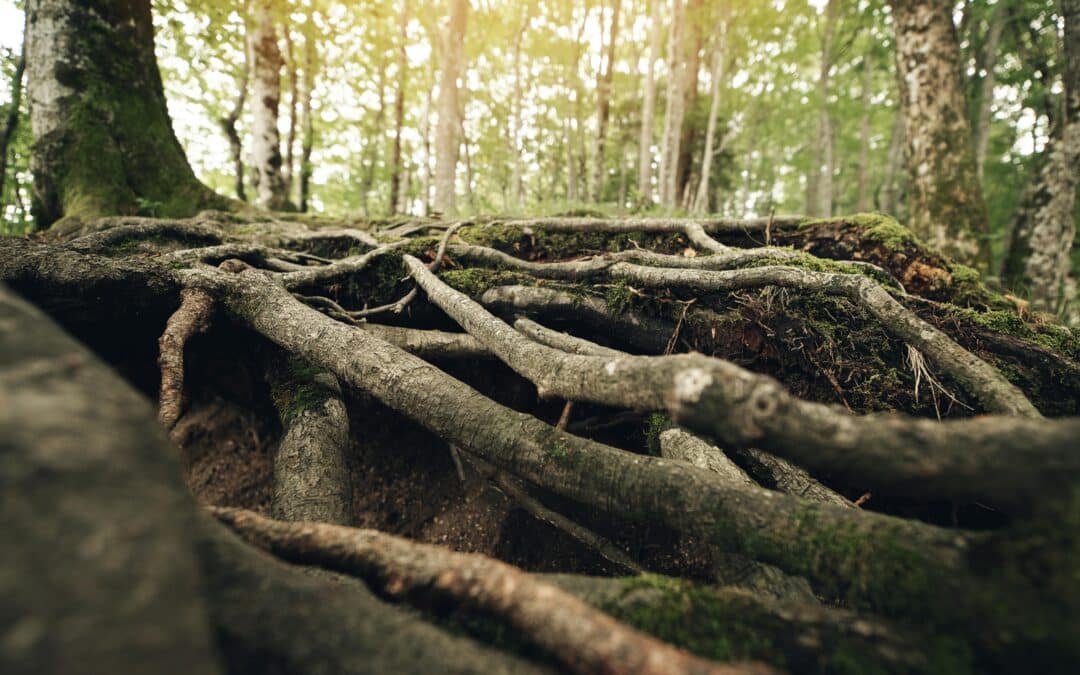
You planted that oak tree years ago, and it looks great. But depending on how close it sits to your home, that tree may be quietly working against your foundation in ways you can’t see from the surface.
Tree root damage to foundations is one of the most underestimated causes of structural problems for central Indiana homeowners. It’s slow, it’s hidden, and by the time the symptoms appear inside your home, the damage is often well underway.
Here’s what’s happening underground — and how to protect your home.
How Tree Roots Damage Foundations
Tree roots don’t typically punch through solid concrete the way most people imagine. The damage usually happens in one of two ways — and both are serious.
Root Intrusion Through Cracks and Joints
Concrete foundations develop hairline cracks over time from normal settling and seasonal movement. Tree roots, always seeking moisture, find those cracks and grow into them. As the root expands, it widens the crack from the inside out. What started as a minor, low-priority crack becomes a serious structural breach — and the root keeps growing.
The same thing happens at construction joints, around pipe penetrations, and at any point where two surfaces meet imperfectly. Roots don’t create the vulnerability — they exploit it.
Soil Moisture Extraction (The Drying Effect)
This one surprises homeowners. Large trees have extensive root systems that pull enormous volumes of moisture from the soil — sometimes hundreds of gallons per day during peak growing season. In central Indiana’s clay-heavy soil, that moisture extraction causes the clay to shrink and contract significantly.
When the soil beneath or alongside your foundation dries out and shrinks, it creates voids — empty spaces where the soil used to support the foundation. The foundation then shifts or sinks into those voids. This is differential settlement caused entirely by a tree you may never have considered a threat.
The opposite happens during a wet season: the tree’s roots are less aggressive, moisture returns to the soil, and the clay swells back up. Your foundation is being pushed and pulled by a seasonal cycle driven by root activity — year after year.
Which Trees Pose the Greatest Risk?
Not all trees are equally problematic. The risk depends on species, mature size, and proximity to the foundation. These are the highest-risk trees for Indiana homeowners:
- Silver maple — extremely aggressive root system, one of the most common culprits
- Willow — roots actively seek water sources, including foundation cracks and drainage systems
- American elm — wide-spreading surface roots that can undermine footings
- Cottonwood — fast-growing with invasive roots that spread far from the trunk
- Oak — lower risk when young, but mature oaks have massive root systems that alter soil moisture significantly
- Norway maple — shallow, wide root system that competes aggressively with soil stability near structures
As a general rule, a tree’s root system can extend 2–3 times the diameter of its canopy. A large shade tree 20 feet from your house may have roots actively beneath your foundation.
Warning Signs Tree Roots May Be Affecting Your Foundation
These symptoms don’t definitively prove root damage — but they’re worth taking seriously, especially if you have large trees near your home:
- Cracks in basement walls or exterior masonry that are growing or changing shape
- Uneven or sloping floors near an exterior wall closest to a tree
- Sticking doors or windows on the side of the home facing a large tree
- Visible root flares pushing up against the foundation exterior
- Drywall cracks appearing diagonally from door or window corners
- Drainage problems around the base of the home where roots may be disrupting drainage systems
- Gaps opening between walls and ceilings or floors
Any combination of these symptoms near a large tree is a signal to get a professional assessment before the damage progresses further.
What Can Be Done About It?
Tree root foundation damage is fixable — and in most cases, the tree doesn’t have to come down.
Root Barriers
A physical root barrier — a vertical panel installed in the soil between the tree and the foundation — redirects root growth away from the structure. These work best as a preventive measure or in early-stage situations where roots haven’t yet reached the foundation.
Foundation Stabilization
When soil shrinkage or root intrusion has already caused settlement or wall movement, the foundation itself needs to be addressed directly:
- Helical or push piers — installed beneath the affected footing, these transfer the foundation’s load past the unstable, moisture-variable soil layer to stable bearing soil or bedrock below. Settlement stops. In many cases, some lift is recoverable.
- Carbon fiber straps or wall anchors — if lateral soil pressure or root intrusion has caused walls to crack or bow, these systems stabilize the wall and halt further movement.
- Crack repair and waterproofing — once structural stability is restored, cracks exploited by roots are sealed to prevent future intrusion and water infiltration.
Every repair from Trusted Foundation Solutions is backed by a satisfaction guarantee and a lifetime warranty. You’re not buying a temporary patch — you’re investing in a permanent fix for your home’s most important system.
Central Indiana Homeowners: This Problem Is More Common Than You Think
The neighborhoods of Indianapolis, Carmel, Fishers, Noblesville, and Greenwood are full of mature trees — which is part of what makes them beautiful places to live. But those same mature trees mean root systems that have had decades to grow, spread, and interact with the foundations around them.
If you have large trees within 20–30 feet of your home and you’re seeing any of the symptoms above, a foundation inspection is the right next step.
Trusted Foundation Solutions offers free inspections throughout central Indiana. We’ll assess your foundation, identify any movement, and give you a straightforward explanation of what’s happening — and what it takes to fix it.
Call us today or fill out our contact form to schedule your free inspection. The tree isn’t going anywhere — but neither should your foundation.