
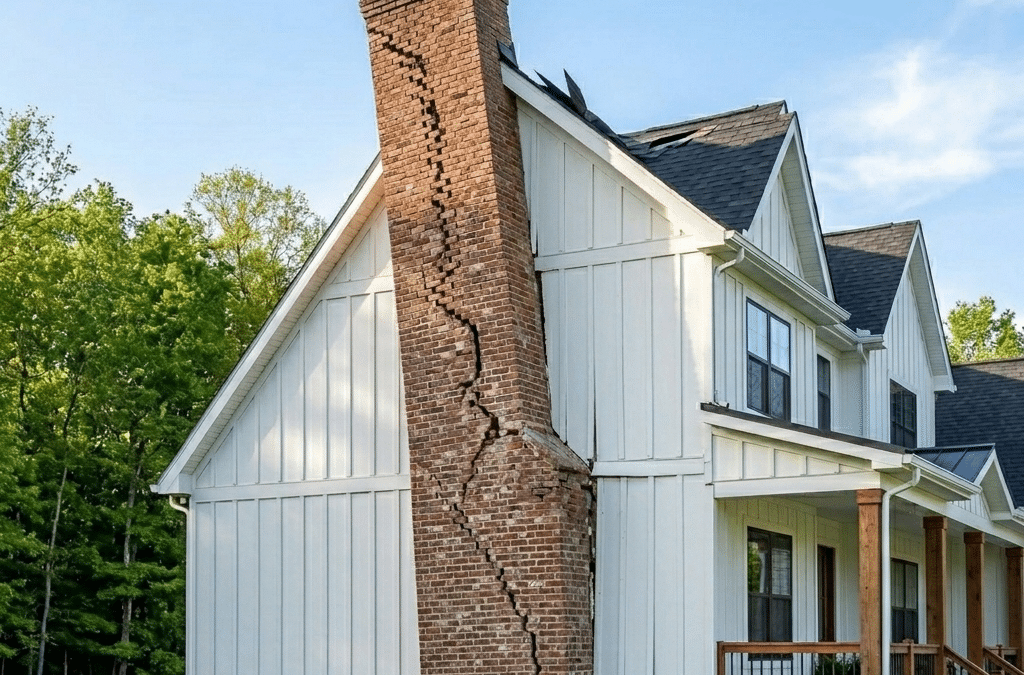
Why Chimneys Crack: The Real Cause
Most homeowners assume chimney cracks are a weathering or masonry problem. Sometimes they are. But when cracking is paired with separation from the house, tilting, or gaps opening up at the roofline — that’s foundation settlement, not surface deterioration.
Chimneys sit on a separate footing from the rest of your home. When the soil beneath that footing shifts, compresses, or washes away, the chimney sinks independently from the house — and the crack is where those two structures are pulling apart.
Common causes include:
- Soil settlement — expansive clay soil in central Indiana swells and shrinks seasonally, destabilizing footings over time
- Poor compaction — soil that wasn’t properly compacted during original construction continues to compress for years
- Erosion — water from poor drainage or grading removes soil from beneath the chimney footing
- Freeze-thaw cycles — Indiana winters repeatedly freeze and thaw the soil, causing gradual heaving and shifting
- Tree root intrusion — roots from nearby trees displace soil and undermine footings
The crack you see on the outside is the result of movement that’s been building for years. The footing is what needs attention, not just the brick.
A cracked chimney is easy to dismiss. It’s outside, it’s up high, and it’s easy to tell yourself it’s just old mortar. But a chimney that’s cracking, separating from the house, or visibly leaning is one of the clearest signs that something is wrong with the foundation beneath it.
Chimneys are heavy, rigid structures sitting on their own footing — and when that footing shifts, the chimney is the first place you’ll see it. Here’s what’s actually happening and what a real fix looks like.
Warning Signs Your Cracked Chimney Is a Foundation Issue
Knowing when a chimney crack is cosmetic versus structural is critical. Watch for these red flags:
- Gap between chimney and house — visible separation at the exterior wall or roofline
- Chimney leaning away from the house — even a slight tilt warrants immediate inspection
- Stair-step cracks in the brick — diagonal cracking through mortar joints signals differential settlement
- Cracks that are wider at the top than the bottom — indicates the footing is sinking on one side
- Interior cracks near the fireplace — drywall or plaster cracking around the firebox can mirror exterior movement
- Fireplace doors that no longer close properly — the frame has shifted with the chimney
Any one of these is a reason to get a professional assessment. Multiple signs together mean the problem is actively progressing.
Is a Leaning Chimney Dangerous?
Yes — and it can become dangerous quickly. A chimney that has separated from its footing and is actively tilting is a collapse risk. Beyond the obvious safety concern, a compromised chimney can allow:
- Water intrusion through gaps into the attic or wall cavity
- Carbon monoxide leaks if the flue is cracked or misaligned
- Accelerating structural damage to the roofline and exterior wall where the chimney meets the house
This is not a wait-and-see situation.
How a Cracked or Leaning Chimney Is Repaired
Chimney crack repair done correctly addresses the foundation movement — not just the visible damage. Here’s what professional chimney stabilization looks like:
- Helical piers — Steel piers are driven into stable soil or bedrock beneath the chimney footing, stopping movement and in many cases lifting the structure back toward its original position
- Push piers — Hydraulic push piers transfer the chimney’s load past the failing soil to load-bearing strata below
- Footing repair or reinforcement — In some cases the existing footing can be repaired and reinforced before further movement occurs
- Masonry restoration — Once the foundation is stabilized, cracked brick and mortar joints can be properly tuck-pointed and sealed
Patching the brick without stabilizing the footing is a temporary fix. The cracks will return — and they’ll be wider next time. Every chimney stabilization repair from Trusted Foundation Solutions comes with a satisfaction guarantee and lifetime warranty, because the foundation is the fix.
Central Indiana Homeowners: Don’t Wait on a Cracked Chimney
Central Indiana’s clay soil is particularly hard on chimney footings. The same seasonal moisture swings that cause basement wall problems affect the ground beneath your chimney — and because chimneys are isolated structures, they often show foundation movement before the rest of the house does.
If you’re in Indianapolis, Carmel, Fishers, Noblesville, Greenwood, or anywhere in central Indiana and you’re seeing a cracked, leaning, or separating chimney — that’s your foundation sending a signal.
Trusted Foundation Solutions offers free inspections throughout central Indiana. We’ll assess the footing, explain what’s driving the movement, and give you an honest repair plan.
Call us today or fill out our contact form to schedule your free inspection. A cracked chimney doesn’t fix itself — but we can.